State Wildlife Action Plan
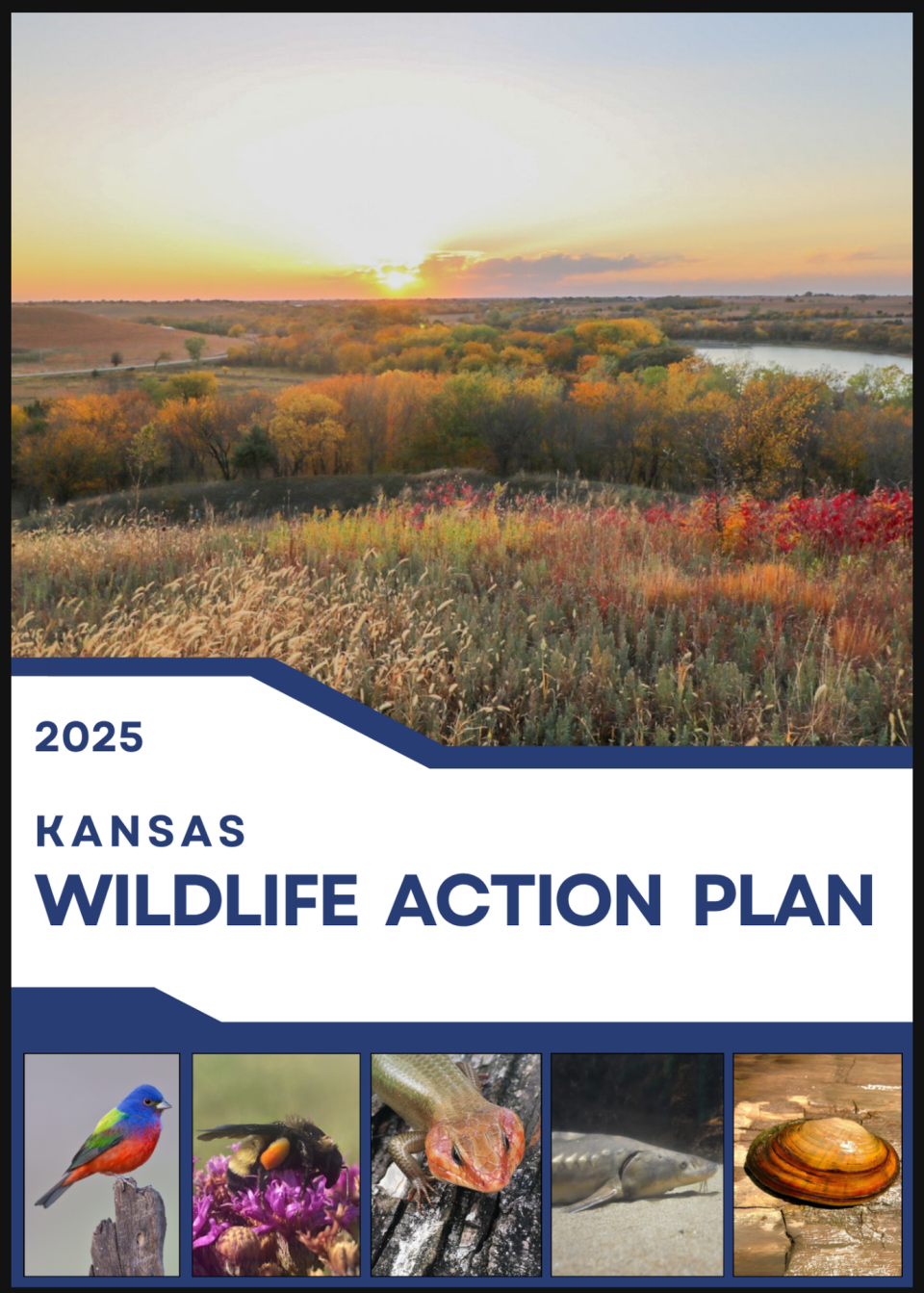 We’re updating the Kansas State Wildlife Action Plan—join us in protecting wildlife and habitats for future generations.
For a draft copy of the proposed 2025 SWAP revisions, visit the following link:
2025 SWAP Draft Revisions
Have input or questions about the 2025 State Wildlife Action Plan? Send us an email by July 18, 2025.
Kansas' State Wildlife Action Plan (SWAP), previously known as the Comprehensive Wildlife Conservation Plan, provides a comprehensive vision for managing Kansas' fish, wildlife, and wildlife habitats. A coalition of more than 3,000 conservation organizations known as Teaming with Wildlife, worked to keep species from becoming endangered by increasing state and federal funding for wildlife conservation.
State & Tribal Wildlife Grants (SWG) are funds that can be used for all wildlife and enables KDWP to fund necessary studies and projects, to keep rare species from becoming endangered, and to keep common species from declining. As a requirement to be eligible for SWG funds, Congress charged each state and territory with developing an approved Wildlife Plan.
The Wildlife Plans were developed by the States to be dynamic, adaptive documents that would guide agency and partner conservation planning for years to come. The Plans are reviewed and revised on a minimum of 10-year intervals as per Element 6 of the original legislation. The Kansas SWAP underwent a comprehensive revision completed in 2016, and a minor revision completed in 2022. The revisions considered many of the changes that Kansas and its wildlife have experienced since the original plan was created (2005). It is important to note that the SWAP is not just a conservation plan for KDWP, but a wildlife conservation plan for the state of Kansas. Collaboration with other agencies, organizations, stakeholders, experts, interested parties, and public participation was requested throughout the revision process, and will be valuable in the implementation process.
The 2022 SWAP has received its official approval from the US Fish and Wildlife Service.
A copy of the Plan is provided below.
This page will be periodically updated as products are produced.
Current Kansas SWAP
Current Kansas SWAP - Revised in 2022 and approved by the US Fish & Wildlife Service
Kansas Monarch Conservation Plan
The Kansas Monarch Conservation Plan is centered on a 20-year objective to conserve, enhance, establish and create pollinator habitat on private, public, and urban lands through non-regulatory, voluntary efforts and actions across the state. Kansas is a national stronghold for monarch conservation and is uniquely positioned to conserve and enhance large acreage and landscapes for monarch migratory and breeding habitat. The Kansas Monarch Conservation Plan serves as a guiding document to support ongoing efforts or new conservation actions, recognizing it will take a multi-sector approach to achieve the set goals. This plan is intended for use by any individual or entity planning, implementing or funding monarch conservation activities in Kansas.
KDWPT has collaborated with individuals from ranching and farming organization, conservation organizations, industry, agencies, academia, and tribal nations, representing 68 organizations, to set voluntary goals for the conservation of monarchs and other native pollinators. If monarch conservation is going to be maintained, enhanced, and created within and between state and federal boundaries, many players are needed. The conservation plan is a living document that will be updated as additional resources, research, or other relevant details are presented.
A copy of the Plan is provided below.
Any questions or comments regarding the Kansas Monarch Conservation Plan can be emailed to megan.rohweder@ks.gov.
Kansas Aquatic Species Recovery Program
Over half of the approximately 184 species of fish and freshwater mussels native to Kansas waters are listed as species of greatest conservation need. These species are identified by biologists as needing proactive conservation action. Of those species, 27 are listed as threatened or endangered by either the Endangered Species Act of 1973, the Kansas Nongame and Endangered Species Conservation Act, or both. The Aquatic Recovery Program seeks to recover, delist, and deregulate populations of these species by working with private landowners to reintroduce species back into Kansas waters in areas where they have gone locally extinct.
Species reintroductions are made possible through the Kansas Aquatic Species Conservation Agreement. This agreement is a Programmatic Safe Harbor and Candidate Conservation Agreement between KDWP and the U.S. Fish and Wildlife Service. The agreement provides regulatory protections to KDWP and allows the agency to conduct species reintroduction efforts for certain state or federally listed species. Kansas and North Carolina are the first states in the nation to enroll in a statewide programmatic agreement for aquatic species. These agreements provide new conservation tools for both states to pursue species recovery.
In Kansas, over 98% of land is privately owned. Consequently, species recovery will not occur without collaborating with conservation-minded property owners. Landowners with property containing adequate habitat that resides within the historical range of a target species can partner with KDWP to pursue species reintroductions. These voluntary partnerships are made possible through landowner agreements provided in the Kansas Aquatic Species Conservation Agreement. Partnering landowners agree to allow stocking of target species within waters on their property and allow KDWP biologists to conduct species surveys to assess reintroduced animal populations. In return, regulatory protections provided to KDWP are passed on to the landowner through landowner agreements. Incidental harm done to target species through otherwise lawful activities (such as habitat enhancement projects, farming, and or ranching) would be covered by a landowner agreement.
Species
How the Agreements Work
The U.S. Fish & Wildlife Service authorizes the KDPW to reintroduce and monitor listed species through an Enhancement of Survival (10a1A) permit.
KDWP then passes on legal protections from incidental take of listed species to a non-federal landowner through a Certificate of Inclusion in the landowner agreement.
Species Reintroduction Projects
For more information on species reintroduction projects, click the individual species tabs at the side of the page. To date, KDWP has completed a re-introductory stocking for the Neosho Mucket, and are in the planning phases of an Alligator Snapping Turtle release.
Landowner Agreement Facts
- Participation in the program is completely voluntary.
- Property owners are not required to fulfill any additional activities outside of the agreement without their consent.
- No additional restrictions for the covered species on the use of the landowner’s land, water, or resources beyond those agreed upon will be imposed.
- Within the agreement, landowners can list any number of legal land-use activities they would like covered from incidental take to listed species. Examples include: farming, ranching, timber harvest, and levee repair. Habitat conservation actions such as riparian tree plantings, cattle exclusion fencing, and stream bank restoration could also be covered.
- Agreements do no hamper economic activities on the enrolled property.
- Agreements allow for flexible scheduling of species reintroductions and monitoring surveys between KDWP and the landowner.
- Terms, including scheduling, target species, and covered land use practices can be amended at any time.
- Landowner is not held responsible for changed circumstances leading to take or failure in species reintroductions such as drought, disease, and other natural disasters.
- Landowners can terminate the agreement at any time but must provide KDWP the opportunity to relocate stocked species within 60 days of notice.
- Neighboring landowner agreements are available to landowners who would like assurances from take of species but do not want KDWP to release or monitor species on their property.
A complete copy of the Kansas Aquatic Species Conservation Agreement can be found here:
To learn more about the Kansas Aquatic Species Recovery Program, contact Trevor Starks, Recovery Program Coordinator at trevor.starks@ks.gov or 785-480-0982.


