Requirements
Making sure you have all the required equipment on your boat before you hit the water makes good sense.
Equipment
Back Flame Arrestor
Inboard, fuel-powered engines must be equipped with a backfire flame arrestor on the carburetor. The flame arrestor must meet USCG approval.
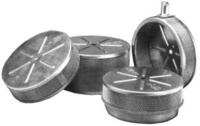
Backfire flame arrestor
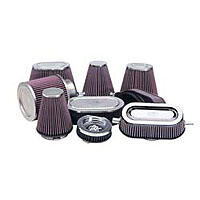
Flame arrestors
Boater Education Safety Education Certificate
Any person under the age of 21 who wishes to operate a vessel (any watercraft designed to be propelled by a motor or sail) without being under direct and audible supervision must complete an approved boater education course.
Direct and audible supervision is defined as a person on board the same vessel and in sufficiently close proximity of the operator's station to enable such person to quickly and safely assume control of such vessel if needed. (KSA 32-1125e) The supervising adult must be at least 18 years of age and either have completed a boater education course or be exempt because they are over they age of 21. No one under the age of 12 may operate a motorized vessel without direct and audible supervision regardless of boater education certification.
You can meet Kansas' Boater Education requirement by taking and passing an approved boating education course (classroom, online, or internet assisted home study.)
Boat Numbers and Decals
Just as you must have a vehicle registration for your car, all vessels powered by gasoline, diesel, electric motors, or sail must be registered and numbered in Kansas. Sailboards and personal watercraft (PWC) are considered vessels.
After registering your boat you will be given an assigned number and expiration decals that will need to be affixed to your boat. Your assigned number must be painted or permanently attached to each side of the forward top half of the boat. Numbers must be vertical block letters at least three inches tall that read from left to right. They must contrast with the background color and be distinctly visible and legible. Hyphens or spaces equal to one letter width must separate letter and number groupings.
A registration decal will also be issued. This expiration decal remains on your boat for the duration of the three-year registration period. Registration decals are displayed in line with the assigned number on each side of the boat.
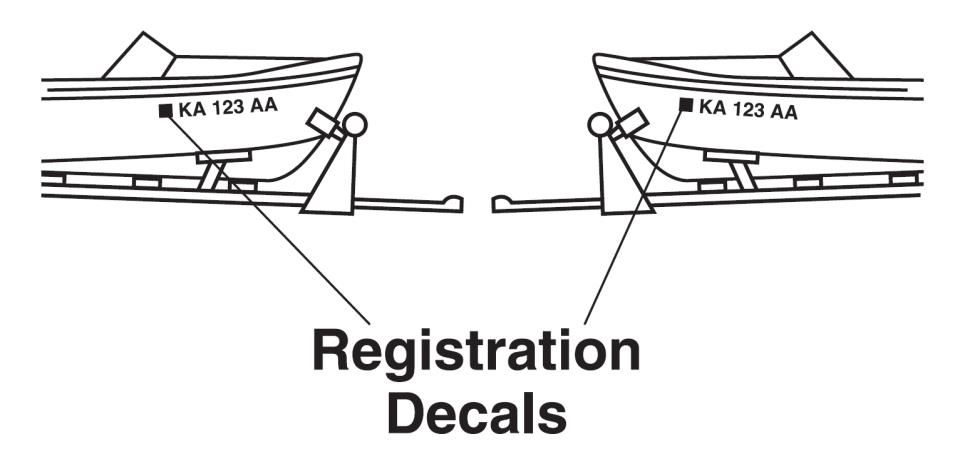
Decal placement
Fire Extinguishers
Every motorboat, unless exempt, must have the correct number, size and type of Coast Guard approved fire extinguishers.
Proper Type of Fire Extinguishers
- Type B–this type of fire extinguisher is for flammable liquids, such as oil or gasoline. Fire extinguishers must say " Marine Type USCG Approved" to be valid.
Length of Boat Requirements
- Less than 16 feet--at least one type BI fire extinguisher if the boat has one or more of the following:
- an inboard engine
- closed compartments where fuel tanks may be stored (live wells, storage, etc)
- double bottom construction not sealed to the hull or not completely filled in with flotation materials
- closed compartments in which combustible or flammable materials are stored
- permanently installed fuel tanks
- 16 feet to less than 26 feet–at least one type BI fire extinguisher
- 26 feet to less than 40 feet–two type BI or one type BII
- Over 40 feet–at least three type BI, or one type BI and one type BII
Motorboats with USCG approved built-in or affixed fire extinguishers are exempt from having a fire extinguisher in the motor area. They are required to have one BI or one BII fire extinguisher in the living space or galley.
Life Jackets (PFDs)
Kansas law requires that all boats have one wearable PFD of proper size, in serviceable condition, not in an enclosed compartment and readily accessible for each person on board. Anyone 12 years old and younger must wear a life jacket at all times when on board a boat (even when anchored) or being towed behind the boat.
Boats 16 feet and longer, except canoes and kayaks, also must carry one throwable flotation device that is in serviceable condition and not in an enclosed compartment.
It is recommended that any person being towed on water skis, kneeboards, or similar devices should wear a properly fitting life jacket.
Each person operating or riding a PWC must wear a properly fitting life jacket.
What is meant by serviceability?
Serviceability means that fastening hardware is not broken and operates correctly, the webbing or straps are not ripped torn or missing. Fabric tears have not resulted in loss of buoyant material and that the buoyant material has not hardened or been contaminated by oil or other liquids. The flotation device must be structurally sound and free of rotted or corroded components.
What is meant by readily accessible?
Readily accessible means the life jackets and flotation devices are plainly visible to the passengers, in an area that can be reached in an emergency without opening a compartment, wrapping material or reaching under part of the boat's hull to get them.
Marine Toilets and Kansas Clean Vessel Pumpout Sites
Human sewage from boats is a source of pollution that poses environmental and health problems. It is important that you dispose of your sewage properly while boating. It is unlawful to place, leave, or discharge sewage into waters of this state.
If you have a recreational vessel with installed toilet facilities, it must have on board an operable marine sanitation device (MSD) that is self contained and incapable of discharging directly into the water. Any MSD with a "Y" valve that could direct waste overboard must be secured so that the valve cannot be opened.
Mufflering
The exhaust of every internal combustion engine used on any motorboat on Kansas waters shall be effectively muffled. The muffler system shall be in good working order and in constant operation.The sound emitted from the engine should not exceed 92 decibels on the "A" weighted scale, when subjected to a stationary sound level test.
Motorboat Sound Muffling; K.S.A 32-1120
Navigation Lights
All boats must use navigation lights while operating on Kansas waters between sunset and sunrise.
It is illegal to operate a PWC on Kansas waters between sunset and sunrise, regardless of ability to use navigation lights.
- Motorboats less than 40 feet long must have navigation lights shown in figures 1, 2, or 3. Motorboats 40-65 feet long must use lights shown in figure 1 or 2.
- Sailboats under sail must have navigation lights shown in figures 4, 5, or 6. Sailboats under power must conform to motorboat navigation light requirements.
- Manually propelled boats shall carry, ready at hand, a flashlight or lantern showing a white light exhibited in sufficient time to prevent a collision.
- Boats at night must display an all-round white anchor light unless anchored in a designated mooring area.
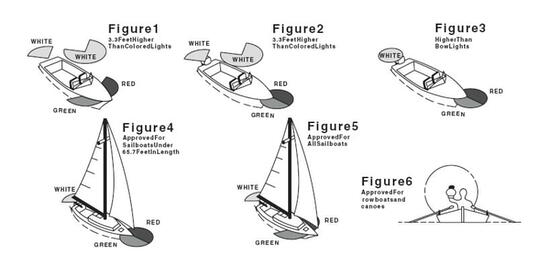
Navigation light setups
Sound Producing Devices
A sound producing device can be a whistle or horn.
All motorboats are required to carry a mechanical sound producing device such as a horn or whistle that is audible up to one mile. Vessels 40 feet and longer are also required to carry a bell made of proper material to sound a tone that may be heard during inclement weather.
PWCs are considered a motorboat and must carry a sound producing device.
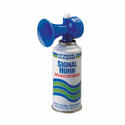
Horn
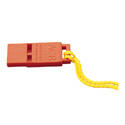
Whistle
Ventilation
All closed-construction , fuel-powered motorboats must have ventilators to remove explosive vapors from engine and fuel tank compartments.
Be sure that the boat is well ventilated before starting, especially after fueling. Gasoline vapors are heavier than air and accumulate in the bottom of the boat, creating a dangerous condition.
Visual Distress Signals
Vessel operators use Visual Distress Signals (VDSs) to signal for help during an emergency. VDSs are classified as day signals (visible in bright sunlight), night signals (visible at night), or both day and night signals. VDSs are either pyrotechnic (smoke and flames) or non-pyrotechnic (non-combustible). All VDSs must be in serviceable condition, readily accessible, and certified as complying with U.S. Coast Guard requirements.
Kansas does not require VDSs when operating on state waters, however, they are recommended safety equipment.
Personal Watercraft
PWCs are Class A boats and must comply with all boating laws, registration procedures, operation and equipment requirements in addition to the regulations specific to PWCs. Any person between the ages of 12 and 20 who wishes to operate a PWC without being under direct and audible supervision must complete an approved boater education course.
Direct and audible supervision is defined as a person on board the same vessel and in sufficiently close proximity of the operator's station to enable such person to quickly and safely assume control of such vessel if needed. (KSA 32-1125e) The supervising adult must be at least 18 years of age and either have completed a boater education course or be exempt because they are over they age of 21. No one under the age of 12 may operate a motorized vessel without direct and audible supervision regardless of boater education certification.
- Every person on board a PWC is required to wear a USCG approved personal flotation device. Inflatable life jackets are not allowed.
- Each person operating a PWC equipped with a lanyard engine cut-off shall attach the lanyard to the operator's person, clothing, or life jacket.
- PWCs are not legal to operate between sunset and sunrise.
- PWC shall be operated at no wake speeds (5 mph or less) within 200 feet of any dock, boat ramp, swimmer, bridge, moored or anchored boats, sewage pump-out facilities, a boat storage facility, concessionaire's facility, or non-motorized watercraft.
- A person shall not operate a PWC unless facing forward.
- If you use a PWC to tow a skier or person on a tube, the PWC has to be equipped with mirrors or you will need a spotter over the age of 12. The person being towed counts towards the capacity of the PWC. (If you have a spotter and are pulling one person, you would need a PWC rated for three (3) people.)
- Maneuvers which unreasonably endanger others are not permitted. This includes, but is not limited to, wake jumping and weaving through vessel traffic.
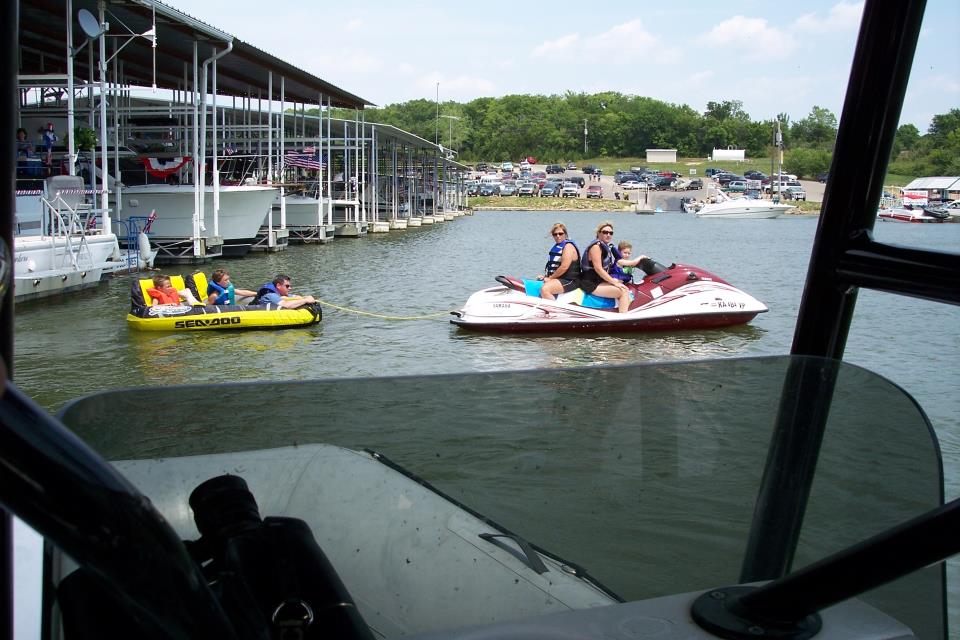
This is an example of over capacity for a PWC. Three on the PWC and three on the tube is six. This PWC is rated for four so they are two people over.
Towed Water Sports Safety
(Water-skiing, wakeboarding, wake-surfing, inflatable tubes, and similar devices)
To be safe and legal, please follow these rules:
- Children 12 years of age and younger must wear a U.S. Coast Guard approved life jacket at all times while on board or being towed by a vessel, even when anchored.
- Boat must be equipped with a wide-angle mirror or have an observer at least 12 years of age in addition to the operator.
- Towed sports are not allowed one half hour after sunset to one half hour before sunrise.
- The operator or observer shall immediately display a bright orange or red flag not less than 12” square immediately after the person(s) being towed are in the water. The flag is not to be displayed while vessel is actively towing.
- It is illegal to operate or manipulate any vessel in such a manner that causes the towed device or person being towed to collide with any object or person.
- It is illegal to operate or manipulate water skis, wakeboards, inflatable tubes, or similar devices while under the influence of alcohol and/or drugs.
Boat Smart. Boat Safe. Wear Your Life Jacket.


