Collecting Permits
Action Permits
Aquatic Nuisance Species
T&E and SINC Species
Conservation Plans
Fisheries Research
 Following are current research projects.
2020 Kansas Licensed Angler Survey
Key Takeaways
- Kansas anglers are predominately male (76%) which is similar to those in the Midwest Region and the United States.
- Twelve-percent (12%) of the Kansas population participates in fishing, compared to approximately 17% in the Midwest.
- Survey results were representative of the Kansas angling population.
- Survey response rates are declining, making it more difficult, expensive, and time consuming to conduct human dimensions research.
- Licensed angler fishing participation is dropping. Eighty-seven percent (87%) of licensed anglers actually go fishing compared to 93% in 2013 and 95% in 2006.
- Bank fishing continues to be the most popular fishing access method.
- Largemouth Bass, Crappie, and Channel Catfish were the three most preferred and targeted species.
- The three most important Fisheries programs and services to anglers were lake rehabilitation, stocking fish, and improving fisheries habitat.
- The three least important Fisheries programs and services to anglers were master angler award, Vamos a pescar-Hispanic/Latino family fishing program, and the mobile aquarium.
- Fisheries Division staff and anglers do not always agree about the importance of fisheries programs and services.
- Fishing motivations differed slightly by sex; females were more motivated to fish “to be close to nature” and for “family recreation” whereas males were more motivated by fishing “for the challenge or sport.”
At the Confluence of Diverse Users and Invasive Carp: the 2022 Kansas River User Survey
Forage Fish Management Plan
The goal of the forage fish management plan is to consolidate best available information to promote proper management of forage fishes and increase sport fish angling opportunities and participation in Kansas. To meet this goal, the forage fish committee developed three objectives.
- Identify current forage fishes in Kansas and their role in fisheries management
- Identify challenges that face fisheries managers in Kansas as they relate to forage fishes
- Determine what direction KDWPT should move as it pertains to forage fish management
To address these objectives, the committee developed an eight-question survey that was disseminated to KDWPT district fisheries biologists in January, 2016. Responses were collected through February, 2016, consolidated, and summarized (Appendix A).
Population Characteristics of Bluegill and Redear Sunfish in Kansas Impoundments
Bluegill are an important component of many aquatic ecosystems in Kansas and contribute to recreational fisheries both as a sport fish and as a baitfish (Steffen 2015). Although Bluegill are an abundant and ubiquitous resource throughout Kansas, anglers only ranked them as the 10th favorite species to catch in the 2013 Kansas Licensed Angler Survey. Additionally, they represent the 7th most fished for species in the same survey (Steffen 2015). Redear Sunfish are likely not differentiated from Bluegill by many Kansas anglers and probably represent a key component of catch and harvest by “sunfish” anglers. Reasons for the relative indifference toward sunfish by Kansas anglers are unknown, but a survey indicated that in general, Kansas Bluegill populations are not producing “trophy” Bluegill (i.e., 257 mm; Steffen, unpublished information) that are sought by anglers. Similarly, standardized sampling results suggest that relative abundance of Bluegill exceeding minimum size for sport harvest (174 mm; Steffen, unpublished information) has decreased since the mid-2000s. Although Kansas reservoir Bluegill and Redear Sunfish populations are routinely monitored with annual standard sampling via fall trap netting (Marteney 2010), a comprehensive evaluation of age and growth of Bluegill and Redear Sunfish was lacking. Additionally, there is interest in using restrictive regulations to improve Bluegill and Redear Sunfish populations. As such, the objective of this study was to estimate Bluegill and Redear Sunfish population parameters (e.g., growth and mortality) from 34 impoundments throughout Kansas. These data are summarized herein and will be used to further Bluegill and Redear Sunfish management in Kansas.
2013 Kansas Licensed Angler Survey Report
The Kansas Department of Wildlife, Parks and Tourism (KDWPT) conducts periodic surveys of its licensed anglers to maintain current information about the fishing characteristics, preferences, and attitudes of its anglers. One goal of the 2013 Kansas Licensed Angler Survey was to get information about special topics including: socialization into fishing, walleye and crappie management, and harmful algal-blooms. Also, KDWPT wanted to know angler demographics and their fishing participation and characteristics; these questions were similar to previous surveys to identify trends. Regularly obtaining human dimensions data from our angling constituents is as important as spring electrofishing, fall test netting, and creel surveys.
Evaluation of Genetic Purity of Kansas Walleye Populations
There are several important considerations regarding walleye Sander vitreus management in Kansas. One such consideration is genetic purity of stocks, including potential hybridization with congeners, and back-crossing with saugeye Sander vitreus × Sander canadensis that are stocked by the Kansas Department of Wildlife, Parks, and Tourism (KDWPT). Introgression of sauger Sander canadensis alleles into walleye populations could have implications for broodstock collection and resulting stocking of progeny, unintended downstream genetic contamination of stocks, and genetic fitness of compromised populations. As such, the genetic purity of Kansas walleye populations is periodically assessed.
In 2000, KDWPT obtained tissue samples from walleye in 10 Kansas reservoirs to determine the genetic purity of walleye populations. In that study, malate dehydrogenase (MDH) and phosphoglucomutase (PGM) activities were examined, which were used to discriminate between walleye and sauger alleles. Data indicated sauger alleles were present in what were thought to be pure Kansas walleye populations. Backcrossing was also detected, but the exact nature of the hybridization was undetermined. Since it has been 15 years since this one and only genetic examination of Kansas walleye populations, further investigation of the purity of Kansas walleye populations was warranted. Therefore, the objective of this study was to investigate the genetic purity of ten priority percid waters in Kansas.
- Black Bass Monitoring
- Effects of water willow
- Flathead Catfish on Kansas River
- Evaluate Freshwater Mussel
- Assessment of channel catfish
- Walleye Populations in Milford Reservoir
Stream Assessment and Monitoring Program
The purpose of the Kansas Department of Wildlife, Parks and Tourism's statewide stream survey program is to document the current range and distribution of stream species. Other objectives include the establishment of recent baseline data on stream fishes and macroinvertebrates to enhance stream management decisions and help assess overall conditions of Kansas streams.
Aquatic Gap
The mission of the Kansas Aquatic Gap Project is to map aquatic biodiversity in Kansas and link it to habitat characteristics.
KDWP Stream Monitoring and Assessment Program Sub Watershed Report - February 2006
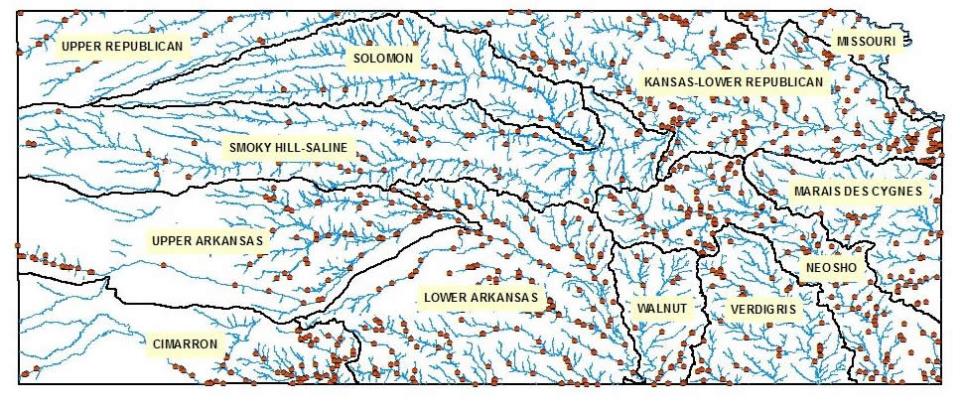 One of the primary goals of the Stream survey program is the assessment of streams and rivers within the 12 river basins located throughout the state. Within each of these systems are areas called HUC (Hydrologic Unit Code). These codes are a way of identifying all of the drainage basins in the United States. A drainage basin is an area or region of land that catches precipitation that falls within that area, and funnels it to a particular creek, stream, river and so on, until the water drains into an ocean. These basins are of various shapes and sizes ranging from a few acres to thousands of square miles. They will cross artificial boundaries such as county, state and international borders. A watershed is a term commonly used in place of drainage basin.
In conjunction with the Kansas Alliance for Wetlands and Streams, KDWP summarized available information from our Stream survey database and was able to generate a Sub Watershed report evaluating fish, mussel, and aquatic macroinvertebrate data collected from over 1000 surveys performed from 1994 through 2004.
The following report is a summary of this information collected from various HUCs throughout the river and stream systems of the state of Kansas.
Contact KDWP About Stream Monitoring
Mark Van Scoyoc
Stream Monitoring Program Coordinator
Kansas Department of Wildlife, Parks and Tourism
Ecological Services Section
512 SE 25th Avenue
Pratt, KS67124
620-672-5911
620-672-2972 (fax)


